#include <stdio.h>
int main() {
   printf("Hello, World! Now let's calculate something.\n");
   return 0;
}Every programmer knows the drill. You learn a new language, you write a few lines of code, and you make the screen say “Hello, World!” It’s the universal starting line.
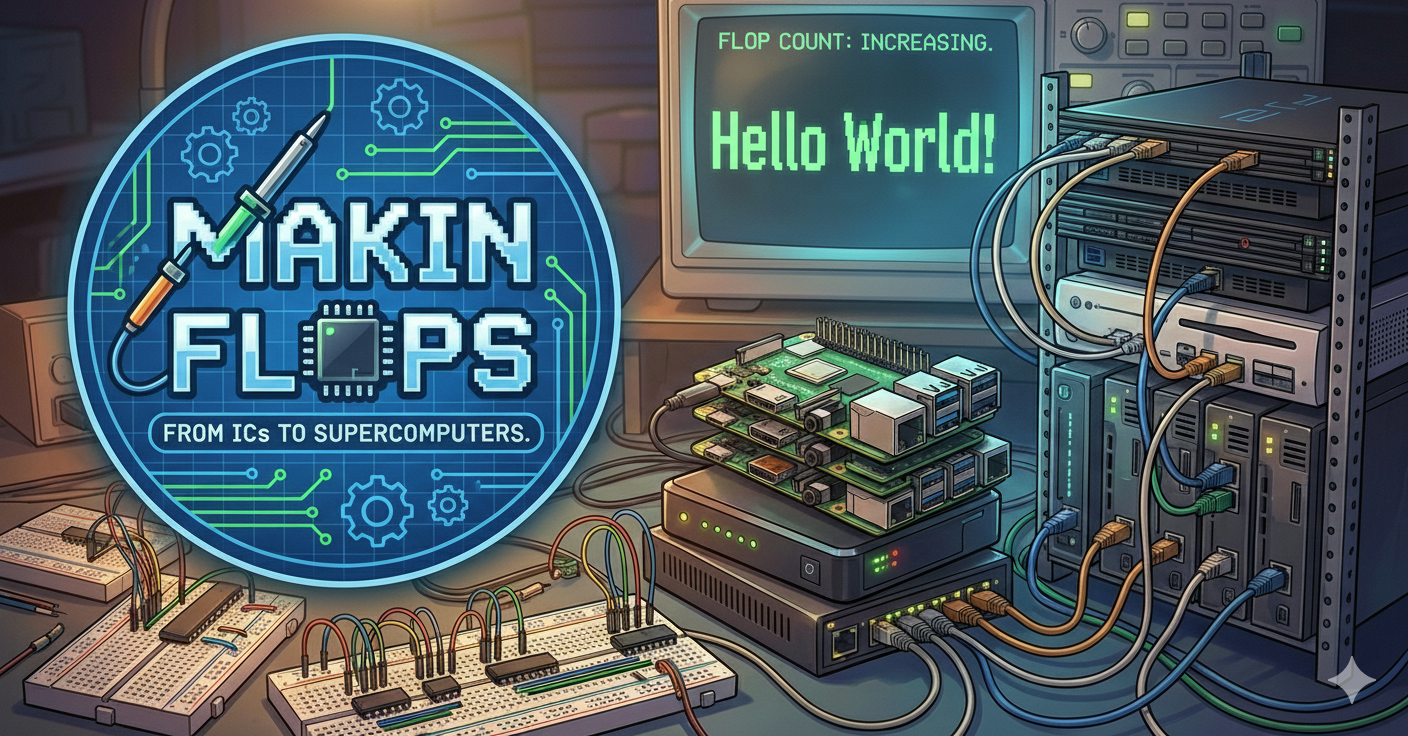
But what if you didn’t just write the code? What if you soldered the logic gates that processed the instructions? What if you ported the Linux kernel to an architecture you invented in your garage? What if your “World” consists of a dozen repurposed 2014 thin clients and an old PlayStation 3, all wired together to crush complex calculations?
If that sounds like your kind of chaos, you’re in exactly the right place. Welcome to the Makin Flops blog.
(And if you stumbled here looking for beach sandals… we are so, so sorry. But stick around, you might learn something cool about supercomputing.)
What is “Makin Flops”?
In the high-end tech world, FLOPS (Floating Point Operations Per Second) are usually bought with massive budgets, liquid cooling, and bleeding-edge silicon.
We take a different approach. We are the architects of the unconventional. We believe that compute power shouldn’t just belong to the mega-corporations with server farms the size of football fields. We are obsessed with e-waste alchemy—taking the hardware everyone else threw away and squeezing every last drop of performance out of it.
What to Expect on this Blog
We’re launching this blog to document our journey, share our code, and prove that you don’t need a million dollars to build a supercomputer. Here is what you can expect to see rolling out over the next few months:
- The Island of Misfit Hardware: Deep dives into building heterogeneous clusters. We’ll show you how we network old game consoles, discarded SBCs (Single Board Computers), and ancient thin clients into a unified compute fabric.
- Silicon Alchemy: Step-by-step guides on building CPUs from discrete logic components. If you’ve ever wanted to see a breadboard calculate $\pi$, we’ve got you covered.
- Software Wizardry: Hardware is nothing without the software to make it sing. Expect tutorials on stripping down Linux kernels, writing custom toolchains for scratch-built architectures, and configuring MPI (Message Passing Interface) to make all these mismatched parts talk to each other.
- Benchmarks of the Absurd: We will benchmark our Frankenstein clusters against modern hardware. Will a cluster of 30 old TV set-top boxes beat a modern laptop? We’re going to find out.
The Open Source Ethos
We aren’t keeping any secrets. Every custom compiler, every modified kernel, and every bizarre wiring diagram will be open-sourced and documented right here. We want you to dig through your closets, rescue that old laptop from the recycling bin, and start makin’ FLOPS with us.
“Computing shouldn’t be a spectator sport. Grab a soldering iron and let’s build something weird.”
Stay tuned. Our first technical deep dive is dropping soon, and it involves a stack of enterprise thin clients and a whole lot of Ethernet cables.
Leave a Reply